"The Cabinet of Dr. Caligari" (1919)
The Story
This masterpiece from 1919 has influenced filmmakers, film critics and film in general ever since its debut. It embodies German Expressionism and horror in a way that few other films do. The story opens on a scene of two men talking. The older of the two comments that strange spirits surround and haunt us. The younger asserts that he has a story that is so strange, his companion will not believe it.
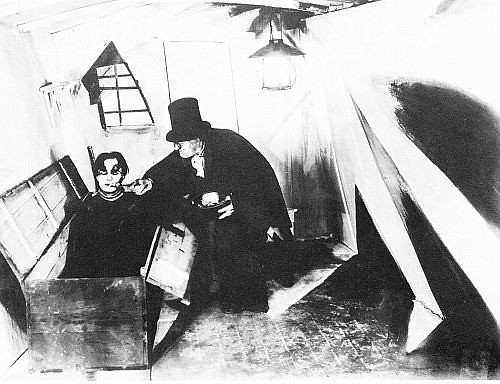
From that moment we go back in time, back to our hero Francis’ hometown fair. Francis (Friedrich Feher) and his friend Alan (Hans Heinrich con Twardowski) are perusing the attractions when they come across a mysterious figure, Dr. Caligari (Werner Krauss), and his unique attraction -- he claims to have a 23-year-old somnambulist who “knows the past and sees the future.” Intrigued by this, Francis and Alan take in the show. Cesare (Conrad Veidt) the somnambulist frightens the onlookers as he is released from his cabinet and awakened from his slumber. Caligari challenges the audience to ask Cesare any question they like to test his foresight. Alan asks when he will die and Cesare answers that it happen before dawn the next day.
As predicted, Alan is murdered during the night and Francis is devastated. He and his fiancee Jane (Lil Dagover) take it upon themselves to investigate the deaths of Alan and other members of the community, with Francis vowing, “I won’t rest until I have solved these horrible crimes.” Caligari orders Cesare to kill Jane, but he becomes infatuated with her and kidnaps her. He is soon pursued and abandons her before collapsing from exhaustion.
Francis discovers that “Caligari” is actually the director of an insane asylum, who has gone insane himself, imitating the life and crimes of a monk who called himself “Dr. Caligari” and employed a somnambulist to commit murders. Francis alerts the asylum employees and Caligari is confronted about his crimes, and then locked up in his own asylum.
We return to present day with Francis telling his companion that Caligari has been locked in the asylum ever since. At first we are left with the feeling that, despite the events that have just occurred, we have a happy ending. Then the twist ending occurs, wherein it is revealed that Francis is the insane one, locked away in an insane asylum with Jane and Cesare. The asylum director is none other than “Caligari” and as the film ends, he states that now that he knows what Francis’ ailment is, he believes he can treat him.
The Style
The story of “The Cabinet of Dr. Caligari” is pretty incredible on its own. But a large part of what makes the film so effective is the art direction and cinematography. The film consists of sets that are incredible works of art on their own. The sets are dynamic, angular, and jagged, giving an atmosphere of unease. Thick, black lines dominate the background, and although the sets look like sets, they are constructed in such a way that they show depth and dimension. Even the makeup is dark and unnerving, from the dark rings under Cesare’s eyes to Jane’s black Cupid’s bow lips, to the dark lines on Caligari’s gloves and hairline. Indeed, Francis’ insanity is such that it alters the way he sees the world and how he perceives his delusions.
This masterpiece from 1919 has influenced filmmakers, film critics and film in general ever since its debut. It embodies German Expressionism and horror in a way that few other films do. The story opens on a scene of two men talking. The older of the two comments that strange spirits surround and haunt us. The younger asserts that he has a story that is so strange, his companion will not believe it.
From that moment we go back in time, back to our hero Francis’ hometown fair. Francis (Friedrich Feher) and his friend Alan (Hans Heinrich con Twardowski) are perusing the attractions when they come across a mysterious figure, Dr. Caligari (Werner Krauss), and his unique attraction -- he claims to have a 23-year-old somnambulist who “knows the past and sees the future.” Intrigued by this, Francis and Alan take in the show. Cesare (Conrad Veidt) the somnambulist frightens the onlookers as he is released from his cabinet and awakened from his slumber. Caligari challenges the audience to ask Cesare any question they like to test his foresight. Alan asks when he will die and Cesare answers that it happen before dawn the next day.
As predicted, Alan is murdered during the night and Francis is devastated. He and his fiancee Jane (Lil Dagover) take it upon themselves to investigate the deaths of Alan and other members of the community, with Francis vowing, “I won’t rest until I have solved these horrible crimes.” Caligari orders Cesare to kill Jane, but he becomes infatuated with her and kidnaps her. He is soon pursued and abandons her before collapsing from exhaustion.
Francis discovers that “Caligari” is actually the director of an insane asylum, who has gone insane himself, imitating the life and crimes of a monk who called himself “Dr. Caligari” and employed a somnambulist to commit murders. Francis alerts the asylum employees and Caligari is confronted about his crimes, and then locked up in his own asylum.
We return to present day with Francis telling his companion that Caligari has been locked in the asylum ever since. At first we are left with the feeling that, despite the events that have just occurred, we have a happy ending. Then the twist ending occurs, wherein it is revealed that Francis is the insane one, locked away in an insane asylum with Jane and Cesare. The asylum director is none other than “Caligari” and as the film ends, he states that now that he knows what Francis’ ailment is, he believes he can treat him.
The Style
The story of “The Cabinet of Dr. Caligari” is pretty incredible on its own. But a large part of what makes the film so effective is the art direction and cinematography. The film consists of sets that are incredible works of art on their own. The sets are dynamic, angular, and jagged, giving an atmosphere of unease. Thick, black lines dominate the background, and although the sets look like sets, they are constructed in such a way that they show depth and dimension. Even the makeup is dark and unnerving, from the dark rings under Cesare’s eyes to Jane’s black Cupid’s bow lips, to the dark lines on Caligari’s gloves and hairline. Indeed, Francis’ insanity is such that it alters the way he sees the world and how he perceives his delusions.


The Treatment
Of course, one must remember that it’s not enough to simply take what was made nearly 100 years ago and stick it on a DVD. If it’s not taken care of, and if a company doesn’t put any care into it, the impact of the film decreases dramatically through no fault of its original creators. When people say they don’t like silent films, I suspect that they have been the victim of poor restoration and poor presentation, not to mention a pretty poor soundtrack as well). And although the “Caligari” sets themselves lend much to the atmosphere of the film, the way it has been restored adds even more.
I’ll admit it upfront, I’m a huge fan of Kino International. They have restored classic films better than pretty much any other company I know of. And that skill extends to “The Cabinet of Dr. Caligari.” The unique-to-Kino intertitle cards, done very much in the angular, jagged style of the film, add so much to the interpretation of the dialogue. Even the translation of the intertitles from the original German seems to be done with greater care in the Kino version. I cannot stress enough what a difference this makes. Here are some screencaps to help illustrate my point. The tinted, jaggedly worded cards are from the Kino International release, while the other cards are from Film Renters Inc. This version is probably the cheapest release available and can even be downloaded from archive.org, but the quality pales in comparison to that of Kino, and not just when it comes to intertitles.
Of course, one must remember that it’s not enough to simply take what was made nearly 100 years ago and stick it on a DVD. If it’s not taken care of, and if a company doesn’t put any care into it, the impact of the film decreases dramatically through no fault of its original creators. When people say they don’t like silent films, I suspect that they have been the victim of poor restoration and poor presentation, not to mention a pretty poor soundtrack as well). And although the “Caligari” sets themselves lend much to the atmosphere of the film, the way it has been restored adds even more.
I’ll admit it upfront, I’m a huge fan of Kino International. They have restored classic films better than pretty much any other company I know of. And that skill extends to “The Cabinet of Dr. Caligari.” The unique-to-Kino intertitle cards, done very much in the angular, jagged style of the film, add so much to the interpretation of the dialogue. Even the translation of the intertitles from the original German seems to be done with greater care in the Kino version. I cannot stress enough what a difference this makes. Here are some screencaps to help illustrate my point. The tinted, jaggedly worded cards are from the Kino International release, while the other cards are from Film Renters Inc. This version is probably the cheapest release available and can even be downloaded from archive.org, but the quality pales in comparison to that of Kino, and not just when it comes to intertitles.


Aside from the intertitle cards, there is also a discrepancy between the dates cited for the monk Caligari that the asylum director is imitating. The Film Renters Inc. version says he lived in 1093, while the Kino version says 1793. That’s quite a discrepancy. Also, while Kino takes the time to tint the film according to setting, time of day and mood -- as seen in “Intolerance,” “The General” -- the Film Renters version remains in poor and grainy black and white. While tinting isn’t necessarily essential, it does help viewers get a sense of the timeline involved in the story as well as the mood. The lack of tinting could be overlooked if the quality of the black and white film was sharp and crisp as it is in “Metropolis,” but Film Renters’ quality is incredibly inferior to that of Kino. The picture is blurry and, at times, off center, making it harder to watch. Here are some screencaps from both versions of the same scenes. The differences between them are incredible, even though they are (relatively small) screencaps from a computer.


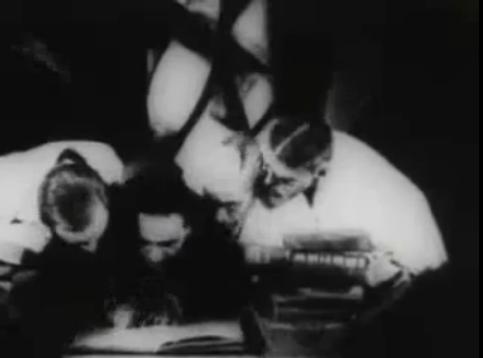
What is, perhaps, the biggest difference between the two, though, is the speed at which they play. Film Renters projects the film at, what appears to be, the typical speed for silent film comedies. This makes the characters’ movements appear frantic and chaotic. While this frantic movement is necessary for silent comedies, it only hurts “Caligari.” Kino, on the other hand, presents the film at what is closer to the speed of talkies. The “talkies” speed, slows the action down slightly, just enough to allow the characters to languish. The difference in speed even causes the running time to range from 51 minutes (Film Renters) to one hour and 11 minutes (Kino).
The Conclusion
“Caligari” is a fantastic film, a fete that director Robert Wiene, unfortunately, could never seem to match, even with the similarly styled “Genuine: A Tale of Vampire.” It’s a twisted, frightening treasure that owes much of its appeal and effectiveness today to a dedicated team who took the time to restore it to its former glory.
The Conclusion
“Caligari” is a fantastic film, a fete that director Robert Wiene, unfortunately, could never seem to match, even with the similarly styled “Genuine: A Tale of Vampire.” It’s a twisted, frightening treasure that owes much of its appeal and effectiveness today to a dedicated team who took the time to restore it to its former glory.
